AI Workbook
What You Can Build

What you can build. Governed domain systems on a platform where structure, controls, and runtime capability already exist.

Most organisations do not need another isolated AI feature. They need domain systems that combine guided work, records, assistants, workflows, documents, outputs, and connected action into a governed way of operating.

AI Workbook makes that possible by letting teams configure domain systems on top of a governed platform instead of reassembling the control model and operating foundation for each new solution.

From ambition to a live governed system

AI Workbook changes the lifecycle as much as the end product. Teams can move from ambition into structure, from structure into governed build, from build into live operation, and from live operation into controlled improvement without repeatedly restarting from scratch.

It also improves the relationship between business innovators and technology leaders. The people closest to the work can shape and test operating ideas inside a governed framework, while architecture and delivery teams get clearer signal about what is worth supporting and scaling.

What gets built is a domain system: guided work surfaces, shared records, embedded assistants, workflow logic, downstream actions, documents, and durable results working together. The organisation focuses on the method, rules, and outcomes that matter in its domain. The platform already supplies the operating foundation beneath that system.
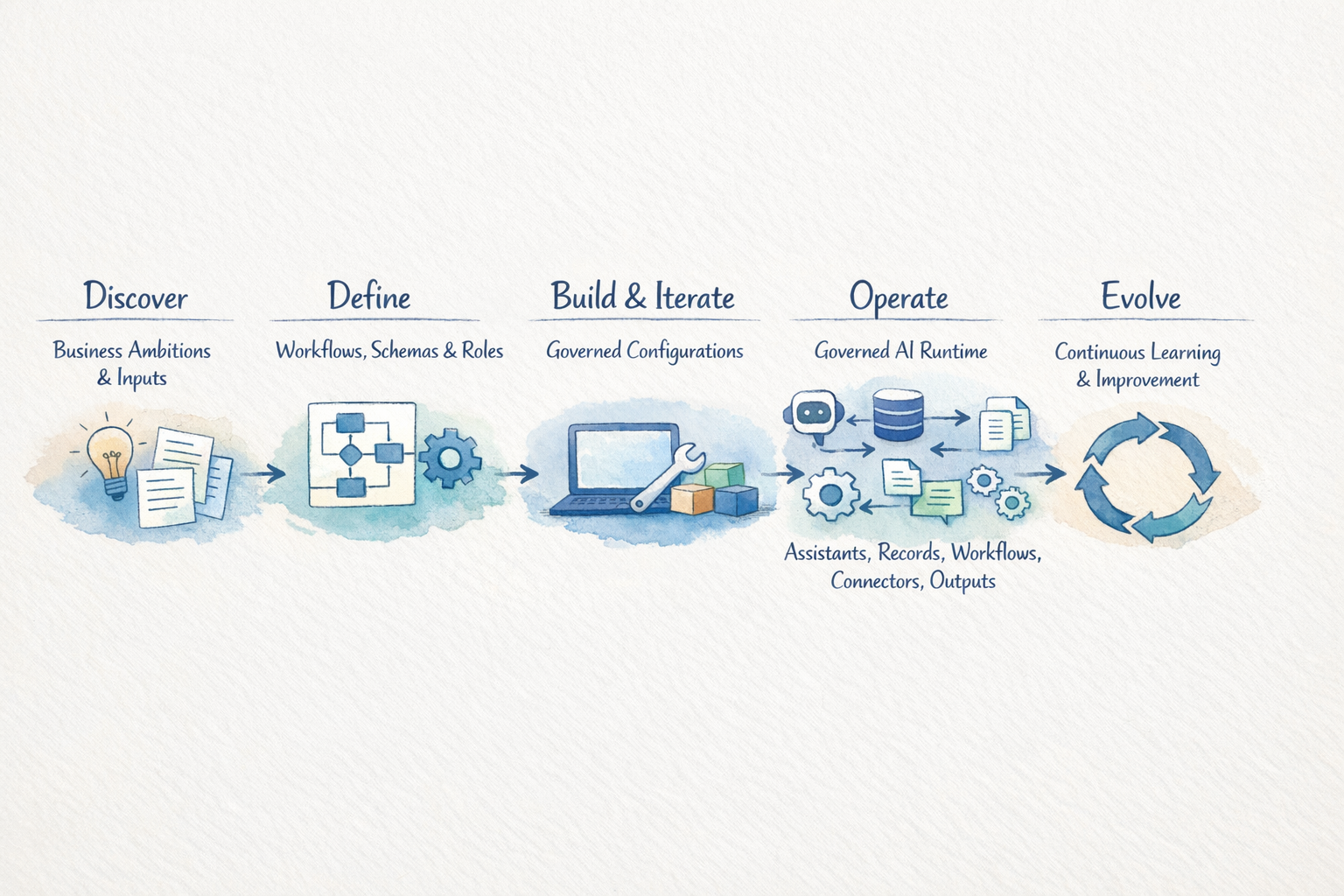
Lifecycle from ambition to governed live system
The value is not only what gets built. It is the path from early ambition to governed operation and ongoing improvement.

What the platform already provides and what the organisation defines

What the platform already provides and what the organisation defines
What AI Workbook already provides
Built-in guardrails for access, runtime behaviour, and review
Guided work, records, and connected action that can be combined into real operating systems
Durable documents, outputs, and reusable platform patterns that reduce rebuild burden
What the organisation still defines
The domain logic, process steps, and decision points
The schemas, prompts, workflows, and review rules that express its method
The user journeys, outputs, and operating standards the system must support
The places where deeper extension or custom engineering are genuinely needed

Configuration-driven does not mean lightweight or disposable. It means teams can shape domain systems through governed structure instead of reopening the whole stack every time requirements move.

Why this model matters

Why this model matters
Faster formation
Teams can move from operating idea to working system without building the full platform estate first.
Safer live use
Guardrails, review paths, and execution boundaries are already part of the system model.
Less reinvention
New systems reuse platform capability instead of rebuilding common foundations in slightly different ways.
Cheaper evolution
Guided work, assistants, workflows, and outputs can change through governed structure rather than repeated full-stack rework.
Clearer ownership
The organisation can separate platform behavior from domain judgment and govern each more cleanly.

What this looks like in practice

What this looks like in practice
Recruitment
A recruitment intelligence system can be configured on the platform with structured entry, operational records, governed assistance, workflows, and durable outputs.
Marketing
Expert method can be turned into a repeatable capture-to-output system designed to compound across stages and channels.

Closing thought

The goal is not to bolt AI onto another tool. The goal is to build domain systems on a governed platform so useful capabilities can form faster, run safer, and evolve with less friction.